
Curriculum
- 11 Sections
- 95 Lessons
- 10 Weeks
Expand all sectionsCollapse all sections
- IntroductionHow the course is put together, and the application you will work against.2
- 1. Foundations — QA & Test Design FoundationsWhat testing is for, and how to choose what to test. No tool, no code.14
- 2.1What quality actually means, and who owns it9 Minutes
- 2.2Manual, automated, and what automation cannot do10 Minutes
- 2.3Test levels: unit, integration, system, end-to-end11 Minutes
- 2.4The test pyramid, the testing trophy, and when each is wrong12 Minutes
- 2.5Functional vs non-functional testing9 Minutes
- 2.6Equivalence partitioning10 Minutes
- 2.7Boundary value analysis10 Minutes
- 2.8Decision tables and state transition testing12 Minutes
- 2.9Pairwise and combinatorial testing10 Minutes
- 2.10Exploratory testing and charters10 Minutes
- 2.11Risk-based test selection: what to automate first12 Minutes
- 2.12Writing a test case that survives a handover10 Minutes
- 2.13Bug reports that get fixed11 Minutes
- 2.14Entry and exit criteria, definition of done9 Minutes
- 1. Foundations — How Software Gets Built: SDLC, Agile & FlowWhere testing sits in the way work actually moves. No tool, no ceremony theatre.6
- 3.1How software gets built: waterfall, V-model, iterative11 Minutes
- 3.2Where testing sits, and why it moved left10 Minutes
- 3.3Scrum from a tester’s seat12 Minutes
- 3.4Kanban, flow, and work in progress10 Minutes
- 3.5Refinement: asking the question before the code exists11 Minutes
- 3.6When the process is the problem10 Minutes
- 1. Foundations — Selectors: CSS & XPath MasteryThe single highest-reuse module in the catalog. Framework-free throughout.14
- 4.1What a locator strategy is, and why most suites fail here9 Minutes
- 4.2CSS selectors: type, class, id, attribute10 Minutes
- 4.3CSS combinators: descendant, child, sibling10 Minutes
- 4.4CSS pseudo-classes worth knowing: nth-child, not, has12 Minutes
- 4.5XPath: absolute vs relative, and why absolute is a trap10 Minutes
- 4.6XPath predicates and indexing11 Minutes
- 4.7XPath axes: parent, following-sibling, ancestor13 Minutes
- 4.8XPath text(), contains(), normalize-space()12 Minutes
- 4.9CSS or XPath: choosing per situation9 Minutes
- 4.10Role, label and text-based locators — the modern default12 Minutes
- 4.11test-id attributes: the conversation to have with developers10 Minutes
- 4.12Locating inside tables, lists and repeated components12 Minutes
- 4.13Dynamic ids, generated class names, and how to survive them12 Minutes
- 4.14Auditing a real page: building 20 resilient locators14 Minutes
- 3. Core automation — LLM Foundations for QAHow the models actually behave. Prerequisite for every other X module.12
- 5.1What a large language model is doing when it answers10 Minutes
- 5.2Tokens, context windows, and why long sessions drift11 Minutes
- 5.3Temperature, sampling and non-determinism10 Minutes
- 5.4Choosing a model: capability, speed and cost trade-offs11 Minutes
- 5.5Prompting patterns that work for engineering tasks13 Minutes
- 5.6Giving context: files, specs, examples, constraints12 Minutes
- 5.7Hallucination: what it looks like in generated tests12 Minutes
- 5.8Where an LLM is reliably useful in QA, and where it is not12 Minutes
- 5.9Tool use and agents: the mental model11 Minutes
- 5.10Reviewing AI output: a tester’s checklist12 Minutes
- 5.11Data, privacy and what you must not paste into a model10 Minutes
- 5.12Cost awareness: tokens, caching, and budget discipline10 Minutes
- 3. Core automation — AI-Assisted Test Generation & RefactoringTool-agnostic techniques. Works with Claude Code, Copilot or Cursor.12
- 6.1From requirement to test cases: prompting for coverage13 Minutes
- 6.2From an OpenAPI spec to an API test suite14 Minutes
- 6.3From a Gherkin feature to step definitions12 Minutes
- 6.4Generating test data and edge cases12 Minutes
- 6.5Converting a manual test plan into automation13 Minutes
- 6.6Refactoring a legacy suite into page objects14 Minutes
- 6.7Migrating between frameworks with an agent13 Minutes
- 6.8Adding assertions an agent proposes but a human ranks12 Minutes
- 6.9Generating unit tests for the code under test12 Minutes
- 6.10The review gate: what must never be merged unread11 Minutes
- 6.11Measuring generated-test quality, not quantity12 Minutes
- 6.12Anti-patterns: tests that assert nothing and always pass12 Minutes
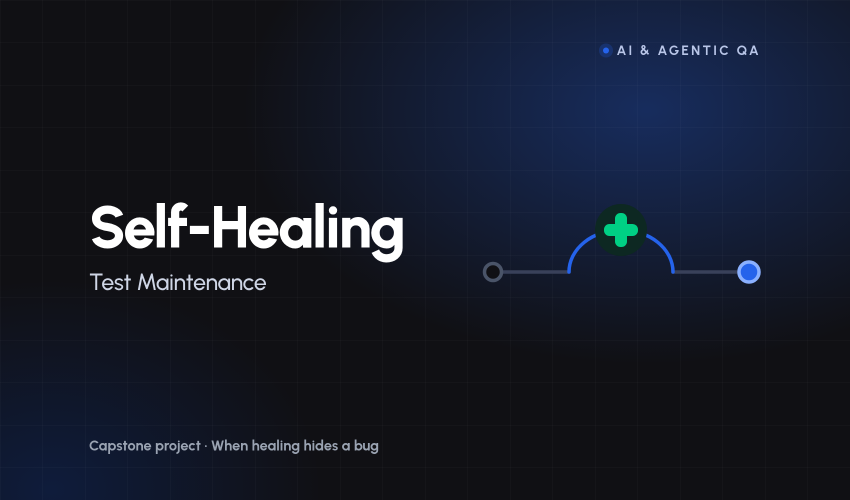
- 3. Core automation — AI for Test Maintenance & Self-Healing10
- 7.1The maintenance problem that self-healing claims to solve10 Minutes
- 7.2DOM and attribute-based healing: how ranking works12 Minutes
- 7.3Visual and computer-vision based healing12 Minutes
- 7.4Healenium and open-source healing for Selenium12 Minutes
- 7.5Healing in commercial platforms: what you are buying11 Minutes
- 7.6The danger: healing that hides a real regression13 Minutes
- 7.7Failure triage with an agent: cluster, explain, propose13 Minutes
- 7.8Automated flake detection and quarantine12 Minutes
- 7.9Keeping locators fresh without healing at all11 Minutes
- 7.10A maintenance policy your team can defend10 Minutes
- 4. Engineering practice — Flakiness, Waits, Retries & ParallelismThe module that separates a suite people trust from one they ignore.10
- 8.1What flakiness costs, and why suites get abandoned10 Minutes
- 8.2Sources of flakiness: timing, state, order, environment12 Minutes
- 8.3Implicit, explicit and fluent waits — and auto-waiting13 Minutes
- 8.4Never sleep: replacing fixed delays with conditions11 Minutes
- 8.5Retries: where they help and where they hide bugs12 Minutes
- 8.6Test independence and ordering11 Minutes
- 8.7Parallel execution: threads, workers, and shared state13 Minutes
- 8.8Sharding a suite across CI machines11 Minutes
- 8.9Quarantine, tagging and flaky-test triage process12 Minutes
- 8.10Diagnosing a flaky test: a live investigation14 Minutes
- 4. Engineering practice — CI/CD Foundations + GitHub ActionsPrimary CI for the whole catalog: it produces a green badge on the student's repo.14
- 9.1Continuous integration, delivery and deployment10 Minutes
- 9.2Where automated tests sit in a pipeline10 Minutes
- 9.3GitHub Actions: workflows, jobs, steps, runners12 Minutes
- 9.4Your first workflow: run tests on push12 Minutes
- 9.5Triggers: push, pull_request, schedule, manual11 Minutes
- 9.6Caching dependencies to keep runs fast11 Minutes
- 9.7Matrix builds: browsers, versions, operating systems13 Minutes
- 9.8Secrets, environments and protected variables12 Minutes
- 9.9Publishing test reports and artifacts12 Minutes
- 9.10Failing the build correctly: exit codes and required checks11 Minutes
- 9.11Scheduled regression runs and nightly suites10 Minutes
- 9.12Reusable workflows and composite actions12 Minutes
- 9.13Self-hosted runners: when and why10 Minutes
- 9.14Reading a failed pipeline like an engineer12 Minutes
- CapstoneThe project this course is marked on.1
- AssessmentA question bank covering the whole course.1
Instructor

1 Student12 Courses
Reviews
Students List
You might be interested in